

HBsAg, HBeAg, anti-HBs: which hepatitis B test means what
Six confusingly similar abbreviations, and the difference between them decides whether you are immune, infected or recovering. Here is the map.
Hepatitis B serology is the most confusing panel in routine pathology, for one avoidable reason: six of the markers share four letters. HBsAg and anti-HBs sound almost identical and mean opposite things — one is the virus, the other is protection from it. This page is the map.
The markers, one line each#
| Marker | What it is | What a positive result means |
|---|---|---|
| HBsAg | Hepatitis B surface antigen — a viral protein | The virus is present. Positive for more than six months means chronic infection. |
| anti-HBs | Antibody against the surface antigen | You are protected — from vaccination, or from having cleared a past infection. |
| anti-HBc (total) | Antibody against the core antigen | You have met the real virus at some point. Vaccination never produces this. |
| anti-HBc IgM | The early class of that antibody | Recent or acute infection, or a flare of chronic infection. |
| HBeAg | Envelope antigen — a replication marker | High replication, and usually higher infectivity. |
| anti-HBe | Antibody against the envelope antigen | Seroconversion — replication has usually, though not always, dropped. |
| HBV DNA | The virus's genetic material, quantified by PCR | How much virus is actively replicating, in IU/mL. |
The combinations that matter#
Vaccinated#
anti-HBs positive, everything else negative. No anti-HBc, because the vaccine contains only surface antigen — this is precisely how vaccination is distinguished from recovery. An anti-HBs level above 10 mIU/mL after a completed course is generally taken as protective.
Recovered from a past infection#
anti-HBs positive and anti-HBc positive, HBsAg negative. You were infected, your immune system cleared it, and you are now immune. You should still tell any doctor prescribing immunosuppressive therapy or chemotherapy, because hepatitis B can reactivate from this state.
Chronic infection, HBeAg-positive#
HBsAg positive, HBeAg positive, HBV DNA usually very high, anti-HBc positive. Often younger patients. The ALT may be entirely normal (the immune-tolerant phase) or raised (immune-active). Which of the two decides whether treatment starts.
Chronic infection, HBeAg-negative#
HBsAg positive, HBeAg negative, anti-HBe positive. If HBV DNA is under 2,000 IU/mL with a persistently normal ALT this is the inactive carrier state, which carries the best prognosis of any chronic phase — but it still needs monitoring, because it can reactivate years later.
Acute hepatitis B#
HBsAg positive with anti-HBc IgM positive, usually with a markedly raised ALT and often jaundice. Most adults clear this without treatment; a minority do not, which is why the six-month repeat test is not optional.
The isolated anti-HBc result#
anti-HBc positive alone, with HBsAg and anti-HBs both negative. It has several explanations: a distant resolved infection with waning antibody, the window period of an acute infection, a false positive, or occult hepatitis B. It needs an HBV DNA test rather than a shrug.
A screening test came back reactive. What next?#
- Repeat HBsAg on a fresh sample, ideally by a different method. Rapid card tests do give false positives.
- If it is confirmed: HBV DNA, HBeAg and anti-HBe, anti-HBc, liver function tests including ALT, AST, bilirubin and albumin, plus a full blood count for the platelet number.
- Hepatitis C, HIV and hepatitis D screening, because the routes of transmission overlap and co-infection changes management.
- An abdominal ultrasound, and elastography for fibrosis where available.
- Hepatitis A vaccination if not immune, and hepatitis B vaccination for your household and partners.
- Repeat HBsAg at six months. That single repeat is what separates a resolved acute infection from a chronic one.
Quantitative HBsAg — worth asking about#
Most laboratories report HBsAg as reactive or non-reactive. A quantitative version, reported in IU/mL, is increasingly used alongside HBV DNA: a low and falling level identifies people more likely to eventually clear surface antigen, and it helps distinguish an inactive carrier from low-level active disease. If it is available to you, a baseline is worth having.
Bring the whole panel to your consultation#
When our physicians review reports in the patient area, the single most common problem is a partial panel — an HBsAg result with no DNA, or a DNA result with no ALT. Any one marker in isolation supports very few conclusions. A complete panel, with dates, is what makes a useful opinion possible.
Questions patients ask
What is the difference between HBsAg and anti-HBs?
HBsAg is a piece of the virus — positive means infection. Anti-HBs is your antibody against it — positive means protection. The names differ by three characters and mean opposite things, which is why results are so often misread.
Does a positive anti-HBc mean I am infected?
Not by itself. It means you have been exposed to the real virus at some point. Whether you are still infected depends on HBsAg and HBV DNA. Anti-HBc positive with anti-HBs positive and HBsAg negative is recovery, not infection.
Why is HBeAg important?
It marks high viral replication and generally higher infectivity, and it defines which phase of chronic infection you are in. Losing HBeAg and gaining anti-HBe — seroconversion — is usually a favourable turn, though not always a permanent one.
I was vaccinated but anti-HBs is negative. What now?
Antibody levels fall over time in some people, and a minority never respond to the first course. Your doctor may recommend a booster or a repeat series and then re-test. If anti-HBc is also positive, that is a different situation and needs an HBV DNA test.
How long after exposure do tests become positive?
HBsAg typically appears four to ten weeks after exposure, and HBV DNA earlier still. A test taken in the first few weeks can be negative despite infection, so a single early negative after a known exposure needs repeating.
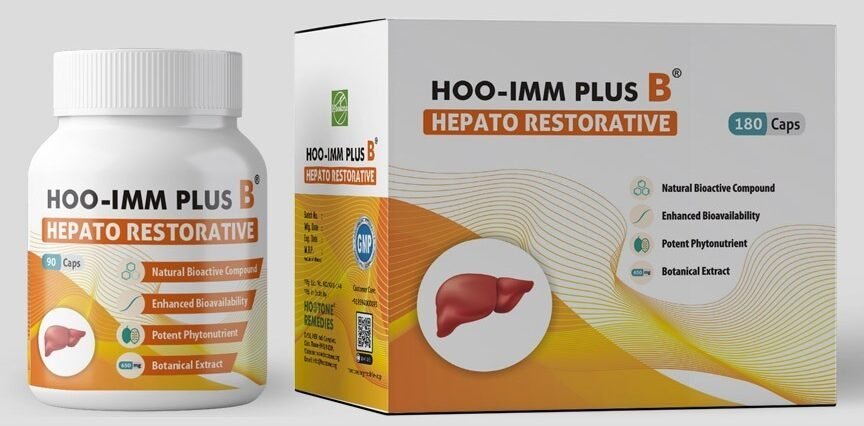
Treatments mentioned in this guide
More on hepatitis b
Can hepatitis B be cured? Yes — with HOO-IMM PLUS-B
Hepatitis B can be cured. With HOO-IMM PLUS-B, patients achieve total cure: HBV DNA negative, HBsAg negative, and anti-HBs positive.

Your hepatitis B viral load, explained: what the HBV DNA number means
One number on your report decides most of what happens next. Here is what IU/mL means, which bands matter, and how to tell a real fall from lab noise.